The internet has never evolved as quickly as it does today. What began as a network for sharing information has transformed into a complex ecosystem that shapes culture, consumer behavior, entertainment, education, and even the way people think.
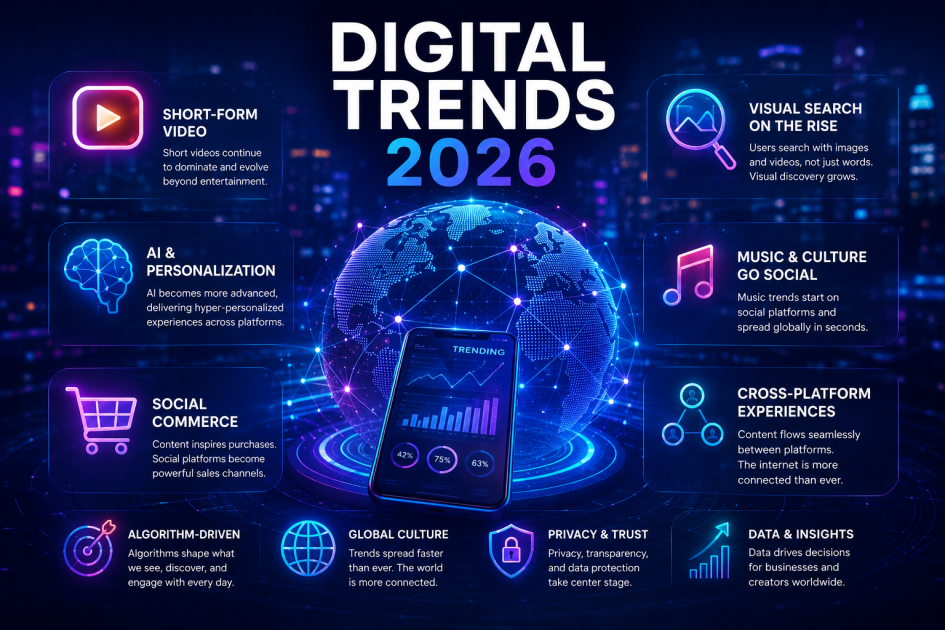
As we move through 2026, several powerful digital trends are redefining the online experience. Artificial intelligence, algorithm-driven recommendations, short-form content, visual search, and social commerce are no longer emerging technologies—they are becoming the foundation of the modern internet.
So what will the internet look like during the rest of 2026 and beyond?
Short-Form Video Continues to Dominate
If there is one format that continues to define digital culture, it is short-form video.
Platforms such as TikTok, YouTube Shorts, Instagram Reels, and similar services have fundamentally changed how people consume information. Users increasingly prefer receiving content in quick, engaging formats that require little effort to consume.
However, short videos are evolving beyond entertainment.
In 2026, users rely on them for:
- Product recommendations
- Educational content
- Travel inspiration
- Financial tips
- News summaries
- Tutorials and how-to guides
Many people now search TikTok or YouTube before using traditional search engines. Instead of reading a lengthy article, they often prefer a 30-second explanation delivered through video.
This shift is changing the way creators, brands, and media companies compete for attention.
Algorithms Are Becoming the New Gatekeepers
The internet once relied heavily on direct searches and website visits. Today, much of the content people see is selected for them by algorithms.
Recommendation systems analyze countless signals, including:
- Watch time
- Click behavior
- Likes and shares
- Search history
- Purchase activity
- Viewing patterns
As a result, users increasingly experience a personalized version of the internet.
Two people opening the same platform at the same time may see completely different content based on their interests and behavior.
This personalization improves convenience but also raises concerns about information bubbles, where users are repeatedly exposed to similar viewpoints while alternative perspectives receive less visibility.
AI Is Becoming Embedded Everywhere
Artificial intelligence is no longer a standalone technology.
In 2026, AI is becoming an invisible layer integrated into nearly every major platform.
AI now assists users by:
- Generating content
- Recommending products
- Improving search results
- Translating languages
- Creating images and videos
- Summarizing information
- Personalizing feeds
Rather than actively searching for information, users increasingly receive AI-curated recommendations based on their interests and online behavior.
This trend is making digital experiences faster, more personalized, and often more predictive.
Search Is Becoming More Visual
Traditional text-based search is facing growing competition from visual discovery.
Users increasingly search through:
- Images
- Videos
- Screenshots
- Visual inspiration boards
This trend is especially strong in industries such as:
- Fashion
- Interior design
- Travel
- Food
- Beauty
- Home improvement
Instead of typing a question, users often upload an image or browse visual content until they discover what they need.
Visual-first platforms are becoming powerful discovery engines that influence purchasing decisions and lifestyle trends.
Social Commerce Keeps Growing
The line between content and commerce is becoming increasingly blurred.
Many online purchases now begin with content consumption rather than intentional shopping.
A user may discover a product through:
- A TikTok video
- A YouTube review
- A creator recommendation
- A Pinterest post
- A viral trend
Only afterward do they search for the item and complete a purchase.
This shift has transformed social platforms into powerful sales channels. Content is no longer simply a marketing tool—it often serves as the first step in the customer journey.
Businesses that successfully combine entertainment, education, and product discovery are likely to benefit most from this trend.
Music Trends Start on Social Platforms
The music industry has undergone a major transformation in recent years.
Traditionally, songs became popular through radio stations, television channels, and music labels. Today, many hits first gain traction through short videos and social media trends.
A single viral clip can expose a song to millions of people within days.
As a result:
- Social platforms influence music charts
- Viral moments drive streaming numbers
- Artists design songs with shareable segments
- Discovery increasingly happens through user-generated content
Music and social media are becoming more interconnected than ever before.
The Rise of Cross-Platform Culture
Internet trends no longer remain confined to a single platform.
A trend might begin on TikTok, spread to YouTube, appear in Google searches, and eventually influence purchasing behavior on e-commerce platforms.
This interconnected ecosystem creates what many analysts call a "cross-platform internet."
Information now travels seamlessly between platforms, accelerating the speed at which trends emerge and spread globally.
For businesses and creators, this means that success increasingly depends on understanding how audiences move between different digital environments.
Global Digital Culture Is Expanding
Language barriers are becoming less significant thanks to advances in AI-powered translation and automated subtitles.
A creator in one country can reach audiences around the world with minimal localization effort.
As a result:
- Global trends spread faster
- International creators gain visibility
- Cultural exchanges increase
- Online communities become more interconnected
The internet is evolving into a more unified global space where ideas can travel across continents in a matter of hours.
Personalization Will Become Even More Advanced
One of the most significant developments of 2026 is the increasing sophistication of personalization.
Platforms are becoming better at understanding:
- User preferences
- Daily habits
- Contextual behavior
- Engagement patterns
- Content interests
Future recommendation systems may adapt not only to what users like but also to when and how they prefer to consume content.
This deeper personalization is likely to improve user experiences while raising ongoing discussions about privacy, transparency, and digital well-being.
What Comes Next?
The future internet is becoming less about searching and more about discovering.
Instead of actively navigating websites, users increasingly interact with content streams curated by algorithms and AI systems.
Several key themes are likely to define the coming years:
- More AI-powered experiences
- Stronger personalization
- Growth of visual discovery
- Expansion of social commerce
- Faster trend cycles
- Increased integration between platforms
The internet is no longer simply reflecting human interests. It is actively shaping them.
Digital trends in 2026 reveal a clear direction: the internet is becoming more personalized, visual, algorithm-driven, and interconnected.
Short-form videos continue to dominate attention. AI is quietly powering more online experiences. Social platforms influence shopping decisions, music consumption, and cultural conversations. Meanwhile, recommendation algorithms increasingly determine what users see, discover, and engage with every day.
Understanding these trends is no longer important only for marketers or technology companies. It has become essential for anyone who wants to navigate the digital world more effectively and make informed decisions online.
